

After spending years discussing offers across kitchen tables, we learned that sellers liked certainty almost as much as a good price.
That advantage hasn’t disappeared.
In August 2025, 28.8% of U.S. home purchases were made entirely in cash, barely below the 29% recorded a year earlier.
Meanwhile, existing-home sales were running at a seasonally adjusted annual rate of just 4 million, down 0.2% compared with July but up 1.8% annually.
Median existing-home prices reached $422,600, making the idea of purchasing a house without borrowing a rather expensive proposition.
Naturally, those figures raise an uncomfortable question.
Who has enough money sitting around to buy a house outright when so many Americans are struggling to afford a down payment?
As it turns out, cash buyers aren’t all wealthy investors, and their considerable presence doesn’t necessarily mean the housing market is doing particularly well.
What the August Numbers Actually Show
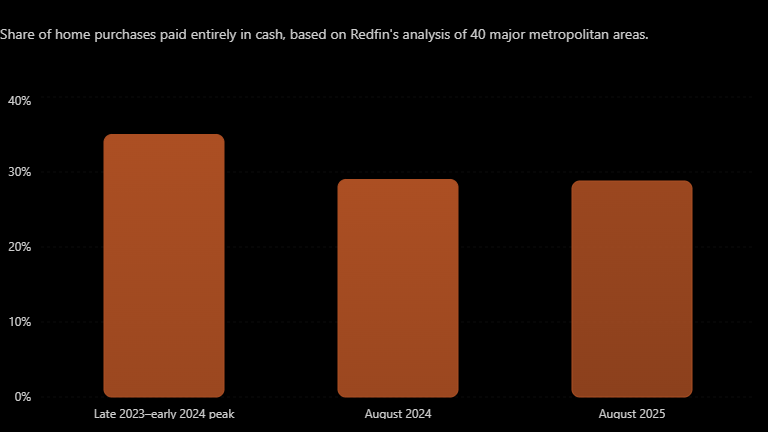
Nearly three in ten homes purchased without a mortgage sounds remarkable, although the historical comparison tells a more interesting story.
According to Redfin’s October 2025 analysis, cash transactions accounted for 28.8% of purchases in August 2025, compared with 29% in August 2024.
Redfin based its findings on county records covering 40 of the country’s most populous metropolitan areas, rather than every residential transaction nationwide.
That difference of just 0.2 percentage points is hardly evidence of a major market shift. Cash buying actually peaked at nearly 35% in late 2023 and early 2024, when mortgage rates were approaching 8%.
By August 2025, rates had settled around 6.5% to 6.6%.
Freddie Mac’s historical mortgage-rate data puts that change into perspective. Average 30-year rates started August 2025 at 6.63% and finished the month at 6.56%. Borrowing costs were easing, although nobody would have mistaken those rates for the exceptionally cheap mortgages available a few years earlier.
Borrowing was still expensive, but the financial incentive to avoid mortgages had weakened somewhat.
Why So Many Buyers Are Paying Cash
Mortgage rates explain part of the enthusiasm for cash purchases.
At 6.5% to 6.6% in August 2025, financing a house meant accepting substantial interest expenses over the life of a mortgage.
Someone with enough money to purchase outright could avoid those payments entirely. However, paying cash also means tying up capital that might otherwise fund investments, retirement expenses, or emergencies.
Not every buyer considers that trade-off worthwhile.
More importantly, cash buyers aren’t a single financial group.
Consider four rather different situations:
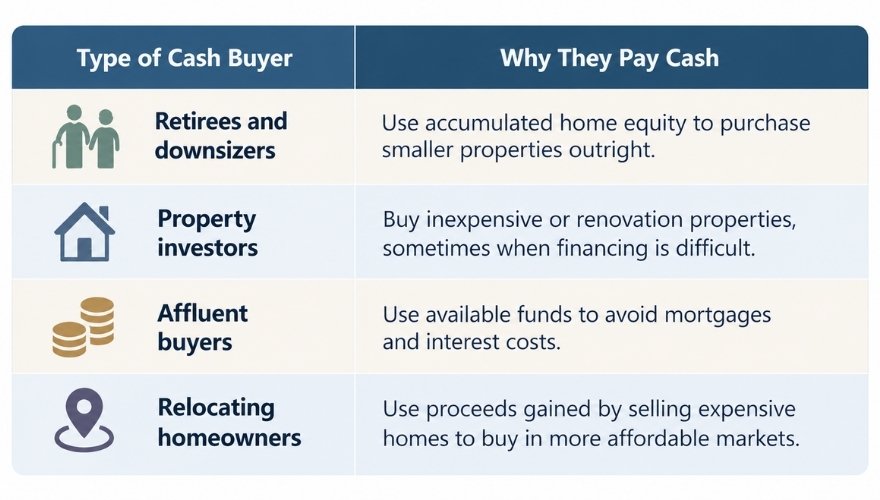
Buying with cash also occurs at opposite ends of the housing market.
According to Realtor.com’s August 2026 research, more than two-thirds of homes selling below $100,000 during the first four months of 2026 were purchased without financing. At the other extreme, more than 40% of homes selling above $1 million were purchased with cash during that period.
Someone purchasing a $75,000 property outright and someone spending $2 million without a mortgage are technically doing the same thing.
Financially, they might have almost nothing in common.
Low-priced properties can attract investors, buyers facing credit restrictions, or purchasers dealing with houses that lenders hesitate to finance.
Expensive properties often attract households with substantial investments or proceeds accumulated through previous property ownership.
Neither category automatically tells us how ordinary first-time buyers are doing.
The Cash Advantage Isn’t Quite What It Used to Be
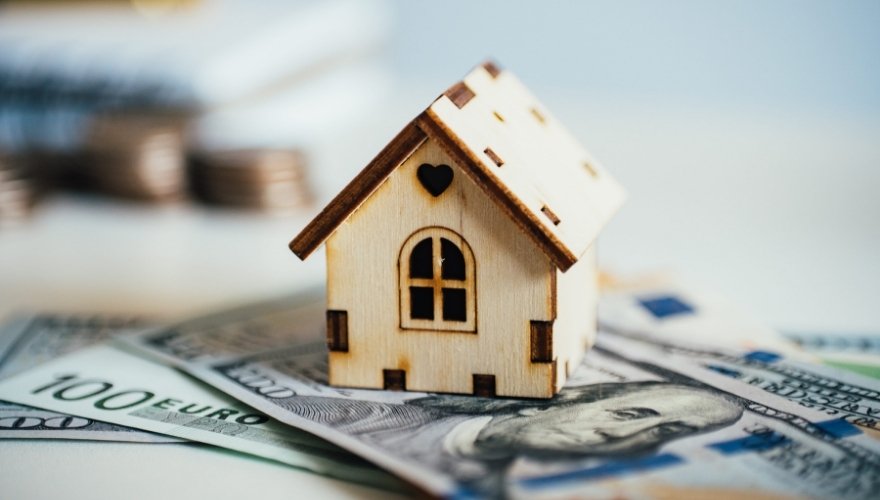
Cash offers have traditionally enjoyed a practical advantage over mortgage-dependent purchases.
Sellers don’t have to worry about a lender rejecting the buyer’s application at the last minute.
Financing contingencies can disappear, and the closing process may move faster. Still, paying cash doesn’t eliminate title problems, inspection discoveries, insurance considerations, or disagreements over repairs.
A questionable roof doesn’t become less questionable because someone paid for the house outright.
Recent market figures also suggest that sellers are becoming less dependent on cash offers. During the first four months of 2026, cash transactions accounted for 31.4% of purchases, compared with 32.3% during the same period in 2025, according to Realtor.com’s analysis.
Overall home sales declined 8.5% annually, while cash transactions fell a larger 11.2%.
Although those percentages describe a different reporting period than August 2025, they suggest that cash buyers were losing some of their earlier market dominance.
Greater housing inventory and slower price growth have helped mortgage-dependent buyers compete.
In some markets, sellers are also reducing their asking prices, giving buyers more room to negotiate. See how price cuts are affecting homes for sale in Salt Lake City and Denver for a closer look at these local trends.
Consider a hypothetical $400,000 listing that has attracted little attention after 60 days. One buyer offers $385,000 in cash, while another offers $395,000 with mortgage preapproval, a substantial down payment, and a conventional financing contingency.
A seller might prefer the certainty of the lower cash offer.
However, the additional $10,000 could make the financed offer more attractive, particularly if the lender has already reviewed the buyer’s income, assets, and credit.
A sensible approach would involve examining both offers’ contingencies, financing deadlines, and likely closing dates rather than automatically choosing cash.
Mortgage preapproval isn’t a guarantee of final approval, and an appraisal problem can still interrupt financing.
As the Consumer Financial Protection Bureau explains, mortgage preapproval isn’t a guaranteed loan offer. A buyer may look financially sound on paper, but final approval still depends on satisfying the lender’s requirements.
Sellers have good reason to examine financing conditions rather than simply accepting the highest number.
Cash Buying Looks Very Different Depending on Where You Live
Real estate has always been local, and cash purchases provide another good example.
Redfin’s August 2025 analysis covering 40 major metropolitan areas found substantial differences in the proportion of homes purchased outright.
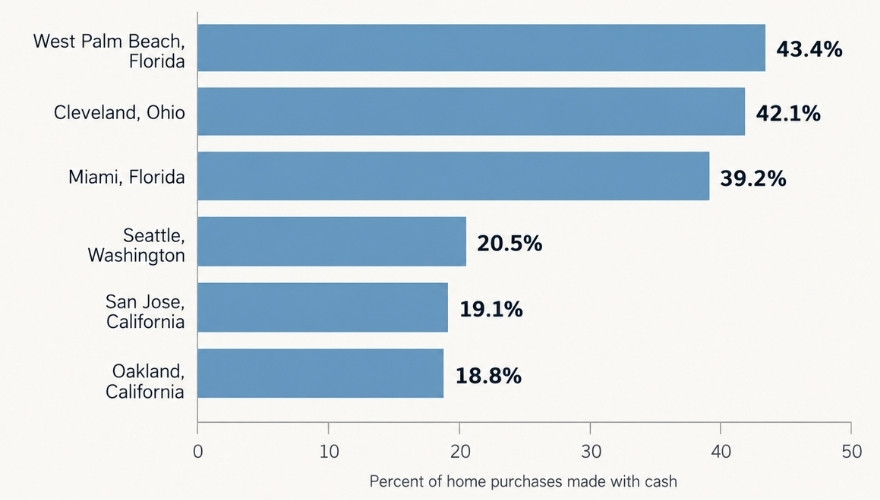
West Palm Beach had more than twice Oakland’s cash-purchase share.
Local retirement populations, investor activity, housing prices, and buyer finances can all influence those differences.
Affordable properties in Cleveland may attract cash investors and longtime homeowners trading properties.
Expensive coastal markets present another situation entirely.
Interestingly, cash purchases increased in Pittsburgh, Austin, and San Francisco during the first four months of 2026 despite the broader national decline.
San Francisco recorded a 7.7% annual increase in the number of cash transactions, consistent with a market where substantial personal wealth can influence purchasing patterns.
That distinction matters because transaction growth is different than an increase in cash buyers’ percentage of total sales.
Of course, a higher percentage of cash purchases doesn’t prove that investors are taking over a particular city.
A buyer in Cleveland and one in San Francisco may both face cash competition, but their financial circumstances can be considerably different.
National averages are useful, though nobody actually buys the national median house.
What This Means for Buyers Who Still Need a Mortgage

Mortgage-dependent buyers haven’t suddenly gained an advantage over everyone carrying cash.
A financed offer still introduces lending requirements, potential appraisal complications, and additional deadlines.
However, summer 2025 brought the strongest buyer-friendly market conditions in more than a decade, according to Redfin’s October 2025 analysis.
Buyers in many markets faced fewer competing offers and had greater opportunities to negotiate.
First-time buyers were no longer routinely confronting ten competing offers, including purchases made entirely in cash or backed by 50% down payments.
In less competitive markets, a reasonable offer below asking price might receive serious consideration.
Buyers may also have more opportunity to retain inspection and financing protections instead of sacrificing them to win bidding wars.
However, another affordability problem was developing.
According to Redfin’s down-payment research, typical down payments reached $70,000 in August 2025, increasing 6.1% annually to the highest dollar amount recorded in the analysis. Median down payments represented 18.6% of purchase prices, compared with 17.8% in August 2024.
Those figures apply to purchases involving mortgages, not cash transactions. Home prices increased approximately 2% during the same period, considerably slower than down payments.
Even with slower growth in some periods, home prices continue to shape affordability across the country. Read more about the latest rise in U.S. home prices and what it means for buyers.
Part of that difference likely involved financially secure buyers accounting for a greater proportion of completed purchases.
Some affluent households were also choosing substantial down payments rather than purchasing homes entirely in cash.
Consider the monthly payment on a hypothetical $400,000 home financed at 6.5% over 30 years.
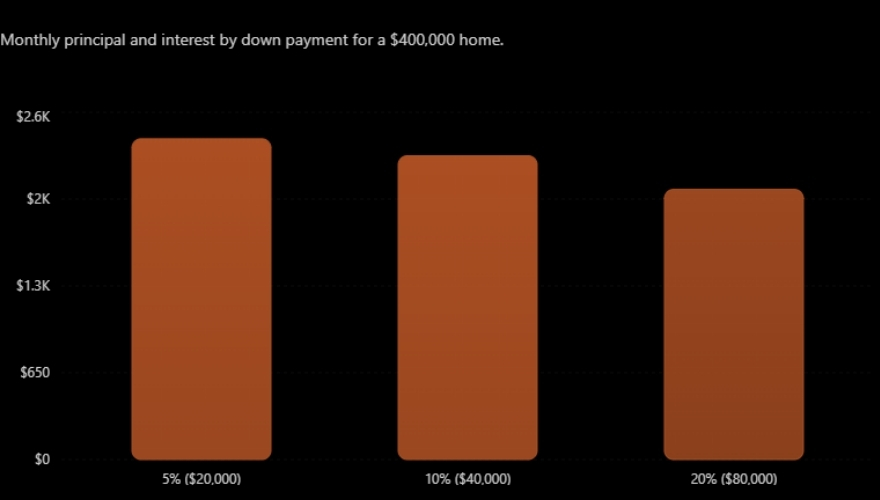
Figures are rounded and exclude property taxes, insurance, HOA fees, and mortgage insurance.
Putting down an additional $60,000 reduces the monthly principal and interest payment by approximately $379.
That is a meaningful difference, although finding another $60,000 isn’t a minor inconvenience for most households.
A 20% down payment can also eliminate conventional private mortgage insurance, potentially reducing monthly expenses further.
Does a Large Share of Cash Buyers Mean the Housing Market Is Healthy?
Not necessarily. Nearly 29% of August 2025 purchases involved cash, yet existing-home sales were running at an annualized pace of just 4 million.
Median prices exceeded $422,000, while high mortgage rates continued limiting affordability. Strong cash activity can exist alongside weak overall transaction volume. More recent figures support that distinction.
According to the National Association of Realtors’ August 2026 existing-home sales report, completed sales declined 2% compared with July, reaching a seasonally adjusted annual rate of 3.98 million.
Housing inventory increased to 1.62 million properties, representing 4.9 months of supply. Median existing-home prices reached $429,100, up 1.6% annually.
August 2026 provided another example. According to the National Association of Realtors, existing-home sales declined 2% monthly to an annualized pace of 3.98 million, while inventory climbed to 1.62 million properties, enough for 4.9 months of supply.
Median prices still increased 1.6% annually to $429,100. Buyers had more choices, but the average house hadn’t suddenly become inexpensive.
Buyers still need enough income to qualify for financing, sufficient savings to cover initial expenses, and the financial capacity to handle years of ownership costs.
A declining cash-sales share may indicate that financed buyers face less competition. It does not prove that housing prices are about to collapse, that investors have abandoned residential property, or that affordability problems have disappeared.
After three decades around real estate, I learned to be suspicious whenever somebody described the entire housing market with one adjective.
Cash Still Matters, but It Doesn’t Tell the Whole Story
August 2025’s 28.8% cash-purchase share was almost identical to the previous year’s figure and considerably below the nearly 35% peak recorded when mortgage rates approached 8%.
During the first four months of 2026, cash transactions declined faster than overall home sales, suggesting that some of their earlier market dominance was fading.
Cash buyers aren’t going away, and sellers will probably always appreciate offers that don’t depend on mortgage approval.
However, buyers who need financing have gained more opportunities to negotiate in markets where inventory has increased, and competition has cooled.
That’s encouraging, although it doesn’t make a $400,000 house inexpensive. For most families, the important question isn’t how their neighbors managed to pay for a home.
It’s how much of a house they can comfortably afford without making the rest of their financial lives considerably harder.

Home Stats Report
Home Stats Report takes a practical, numbers-first look at the American housing market, drawing on decades of real estate experience, historical trends, and the everyday realities of buying and selling homes. Housing has never been as simple as a headline suggests. Home prices rise, mortgage rates change, inventory tightens, and buyers adjust their expectations. Home Stats Report provides market commentary, analysis, and general information for educational purposes only. We do not offer financial, investment, mortgage, or real estate advice.
All reports by Home Stats Report