Not long ago, sellers in some housing markets could put an ambitious price on a home and wait for buyers to compete over it. September 2026 brought a rather different situation.
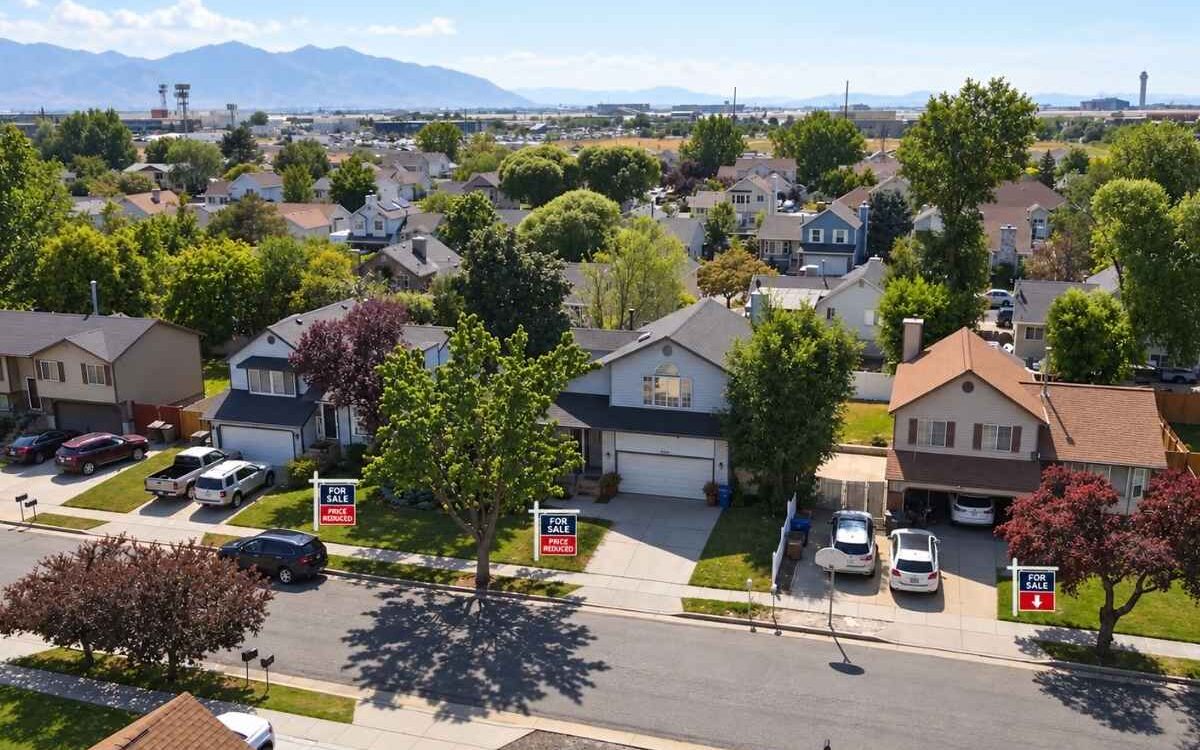
In Salt Lake City, 33.6% of homes listed for sale had experienced an asking-price reduction, while Denver followed closely at 32.1%. Nationally, 20.8% of listings had price cuts, the highest September share since 2018.
Expensive mortgages, cautious buyers, and growing inventory are forcing sellers to reconsider their expectations.
Having spent years watching buyers and sellers disagree over what a house is worth, I would caution against confusing a price reduction with a loss in market value.
Sometimes, an asking price was simply too optimistic in the first place.
Salt Lake City and Denver Have Some of the Highest Price-Cut Rates
September’s housing figures show just how differently local markets are behaving.
According to Realtor.com, Salt Lake City had one of the nation’s highest shares of listings with reduced asking prices, followed closely by Denver and Portland.
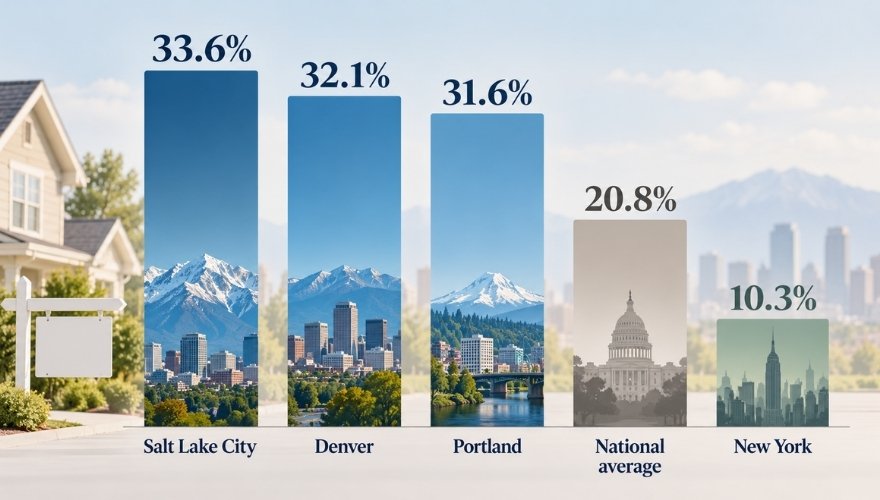
Salt Lake City’s figure exceeded the national average by 12.8%, while Denver was 11.3% higher.
New York offers an interesting comparison. Just 10.3% of its listings experienced reductions, demonstrating why national housing headlines rarely describe what buyers encounter in individual cities.
Another analysis produced a similar result.
During the four weeks ending September 20, 2026, Redfin found that 30.9% of Denver listings had price cuts, the highest share among the 50 largest metropolitan areas it examined.
Different reporting periods and data collection methods explain why Redfin’s figure differs slightly.
One distinction matters enormously here. A 33.6% price-cut rate does not mean home prices declined 33.6%. It means roughly one-third of active listings had undergone an asking-price reduction.
A homeowner cutting $10,000 off an overpriced listing counts just as much as one cutting $50,000.
Why So Many Sellers Are Lowering Their Asking Prices

Mortgage rates explain a considerable part of the problem.
Freddie Mac reported that the average 30-year fixed mortgage rate reached 7.28% on October 1, 2026, compared with 6.34% one year earlier.
For buyers financing hundreds of thousands of dollars, that increase makes a noticeable difference in monthly payments.
Higher borrowing costs also reduce purchasing power. A buyer who qualified comfortably for a particular home last year might struggle to finance that same property today.
Meanwhile, some sellers are still pricing their properties according to expectations established during the pandemic housing boom.
Colorado offers a useful example of how much conditions have changed.
In August 2026, the state had 4.5 months of housing inventory, compared with 3.9 months nationally. Back in August 2021, Colorado had just 1.4 months of inventory.
Months of inventory measures how long existing listings would take to sell at the current sales pace, assuming no additional homes entered the market.
More inventory gives buyers alternatives, reducing the pressure to make quick decisions. Negotiating conditions have changed accordingly.
During April 2022, Colorado homes typically sold for approximately 104% of their asking price. By August 2026, that figure had declined to 98%.
Consider a home listed at $600,000. At 104%, its selling price would be $624,000. At 98%, it would sell for $588,000.
That creates a $36,000 difference under identical listing-price assumptions. It does not mean an actual property’s value necessarily fell by that amount.
Sellers can ask whatever they want. Getting somebody to pay that amount is another matter.
A Price Cut Doesn’t Necessarily Make a Home Affordable
Seeing $30,000 disappear off a listing price can certainly catch a buyer’s attention. Unfortunately, mortgage payments tend to be less impressed by large-looking discounts.
Consider a hypothetical $600,000 home receiving a 5% asking-price reduction.
Assume the buyer makes a 20% down payment and obtains a 30-year fixed mortgage at 7%.
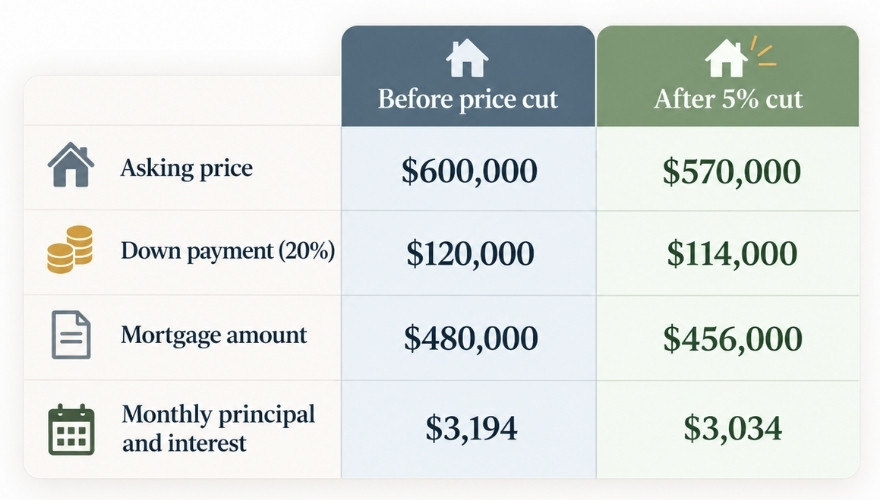
A $30,000 reduction might look generous, but it does not erase the larger affordability problem. We’ve written before about how the house I grew up in became so difficult to buy, and the same issue appears here. Even after a substantial discount, today’s buyer can face a monthly payment that would have seemed extraordinary to an earlier generation.
Over the full 30-year loan term, that monthly difference would total roughly $57,600, assuming neither loan is refinanced or paid off early.
Such savings certainly matter. Still, buyers must account for property taxes, homeowners insurance, maintenance, closing costs, and any applicable HOA fees.
Another detail deserves attention. A seller who originally listed a $570,000 property at $600,000 has not necessarily offered a bargain by reducing the price.
Actual value depends on comparable recent sales, property condition, location, and current demand.
A lower asking price is encouraging. A genuinely affordable monthly payment is considerably more useful.
Buyers Have More Negotiating Power, but the Market Is Still Expensive

National housing inventory is approaching levels not seen since before the pandemic.
Approximately 1.16 million homes were actively listed, an increase of 5.4% compared with September 2025.
Available inventory was just 9.1% below typical pre-pandemic levels, marking the smallest gap recorded since that period.
Yet additional housing choices have not produced stronger buyer activity.
Pending home listings declined 4.1% year over year, suggesting that many potential buyers are unwilling or unable to proceed with purchases.
Redfin’s August 2026 estimates offered another revealing statistic. Nationally, home sellers outnumbered buyers by 58%, the largest imbalance in its records dating back to 2013.
For qualified buyers, such conditions can create opportunities that were difficult to find during the pandemic boom.
Someone considering a home that has been sitting unsold for several weeks may have more room to negotiate the purchase price, request repairs after an inspection, or ask the seller to contribute toward closing costs.
Closing-cost assistance can be especially useful when the buyer has sufficient monthly income but limited cash available after the down payment.
Some buyers may also benefit more through a seller-funded mortgage-rate buydown, subject to lender rules and financing limits.
What These Price Cuts Really Mean for the Housing Market
September 2026 figures suggest that Salt Lake City and Denver are experiencing a shift in pricing power rather than an outright housing collapse.
Local price reductions also deserve some national context. While sellers in Salt Lake City and Denver are adjusting their expectations, U.S. home prices rose 3.7% year over year in August 2026, the fastest annual increase in 12 months.
That is a useful reminder that a growing number of discounted listings does not automatically translate into falling home values nationwide.
Median listing prices reached $564,950 in Salt Lake City, down 3.6% year over year, and $569,900 in Denver, down 4.9%.
Those figures describe asking prices, not final transaction prices.
Changes in the types of homes being listed can also influence the medians.
We remember markets when buyers competed to pay more than the asking price, and others when sellers were simply grateful to get an offer. Neither situation lasts forever.

Home Stats Report
Home Stats Report takes a practical, numbers-first look at the American housing market, drawing on decades of real estate experience, historical trends, and the everyday realities of buying and selling homes. Housing has never been as simple as a headline suggests. Home prices rise, mortgage rates change, inventory tightens, and buyers adjust their expectations. Home Stats Report provides market commentary, analysis, and general information for educational purposes only. We do not offer financial, investment, mortgage, or real estate advice.
All reports by Home Stats Report