

A three-bedroom house with a modest kitchen, one bathroom, and a backyard used to satisfy plenty of American families. Extra bedrooms were nice, but nobody considered a second living room or a dedicated home office essential.
Those houses weren’t perfect. Bathrooms were cramped, storage was limited, and older electrical systems sometimes made running two appliances simultaneously an adventure.
Over time, American homes grew larger. Builders added spacious kitchens, walk-in closets, multiple bathrooms, and rooms that occasionally spent more time collecting furniture than accommodating people.
Now that trend has reversed.
By 2025, the average square footage of a house in new single-family construction had fallen to approximately 2,377 square feet, while the median reached 2,142 square feet. Both figures point to a noticeable shift toward smaller floor plans.
Unfortunately, shrinking floor plans haven’t brought the corresponding price reductions buyers might expect.
What Is the Average Square Footage of a House in the US?
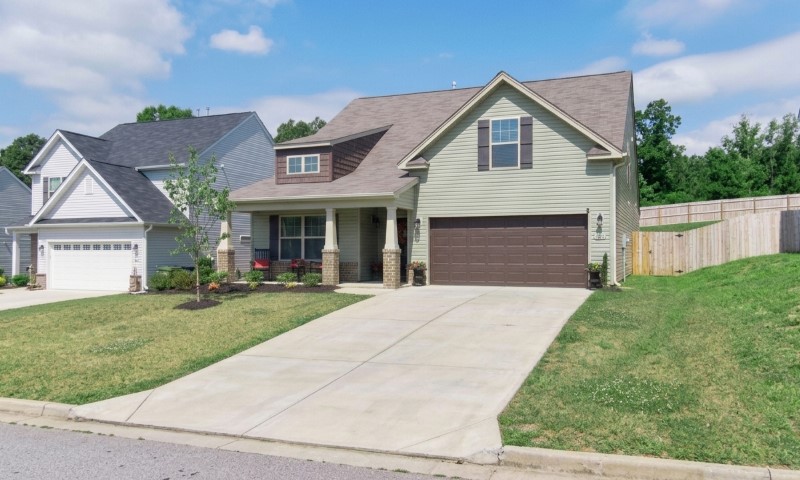
According to the U.S. Census Bureau’s Characteristics of New Housing, the average newly completed single-family home measured approximately 2,377 square feet in 2025, while the median measured 2,142 square feet.
An important distinction often gets lost when these numbers appear in housing headlines. They describe newly completed single-family properties, not the entire American housing stock.
Millions of existing homes were constructed decades ago, when floor plans, household expectations, and building practices were different.
Average and median figures also tell slightly different stories.
Average square footage includes every property in the calculation, meaning unusually large houses can push the result higher. Median square footage identifies the midpoint, with half of newly completed homes larger and half smaller.
For someone comparing a typical new construction property, the median is generally more informative.
How Has the Average American House Size Changed Over Time?
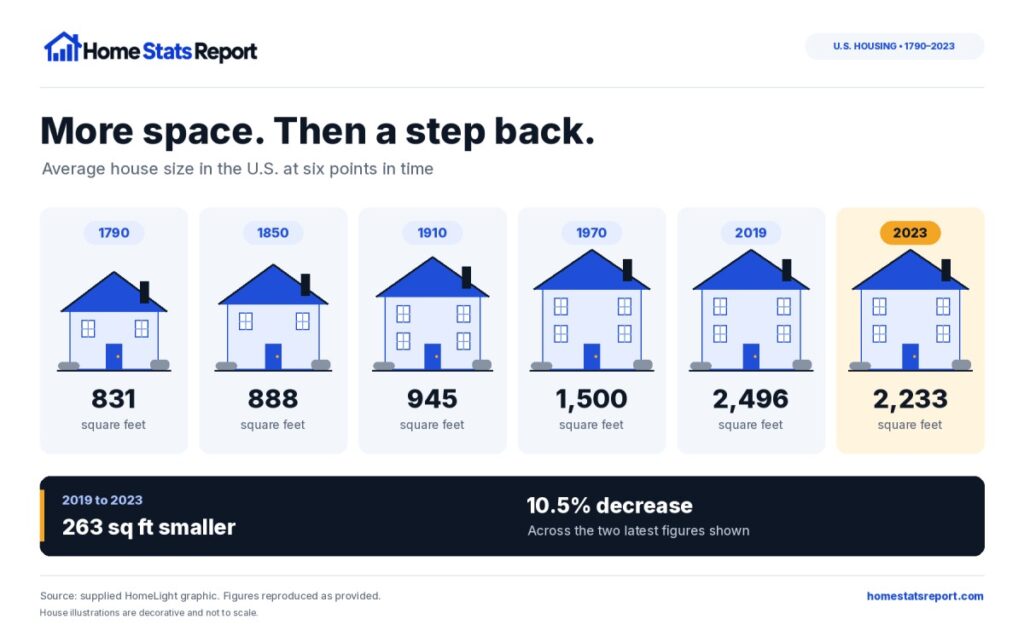
American houses grew substantially throughout the second half of the twentieth century. By the 2010s, spacious new construction had become common in many suburban developments.
Recent figures show how that pattern changed.
Looking at the average square footage of a house over several decades reveals just how much American expectations have shifted.
Larger properties became increasingly common during the housing boom, but recent construction trends suggest that bigger floor plans are no longer the automatic choice.
| Year | Median new single-family home size |
| 2015 | 2,467 sq. ft. |
| 2025 | 2,142 sq. ft. |
| Change | -13.2% |
A reduction of 325 square feet is hardly insignificant. That’s enough space for a bedroom, a small office, and additional storage.
Still, historical perspective matters.
A newly sold American house averaged approximately 2,050 square feet in 1994. By 2024, that figure measured 2,404 square feet.
Even after recent reductions, new construction is generally larger than it was three decades ago.
Housing trends rarely move in straight lines, despite what a dramatic headline might suggest.
Why Are New Homes Getting Smaller?
View this post on Instagram
Builders aren’t suddenly opposed to spacious houses.
Smaller floor plans have become one way to address three connected problems: expensive financing, rising construction expenses, and changing buyer expectations.
High Home Prices and Mortgage Rates
Mortgage rates have a direct effect on purchasing power. Higher borrowing costs are only part of the affordability problem.
A closer look at how much harder buying a modest home has become shows that rising property values have also outpaced income growth for many younger households. Buyers aren’t simply being asked to accept smaller houses. They’re often being asked to spend a larger share of their earnings to purchase them.
When rates increase, buyers generally qualify for smaller loans unless their income or down payment increases enough to compensate.
Consider two hypothetical properties financed with a 30-year fixed mortgage at 6.5% interest and a 20% down payment.
| Home price | Monthly principal and interest |
| $350,000 | $1,770 |
| $400,000 | $2,023 |
| Monthly difference | $253 |
Those payments exclude property taxes, insurance, maintenance, and any homeowners association fees.
A $50,000 reduction in purchase price could save approximately $253 monthly under these assumptions.
For buyers already working close to their budget limits, that difference can determine which property is financially realistic.
Builders have responded by reducing square footage, simplifying floor plans, and offering smaller models at lower starting prices.
A smaller house doesn’t guarantee affordability, but it can help reduce the amount buyers need to borrow.
Rising Construction and Land Costs
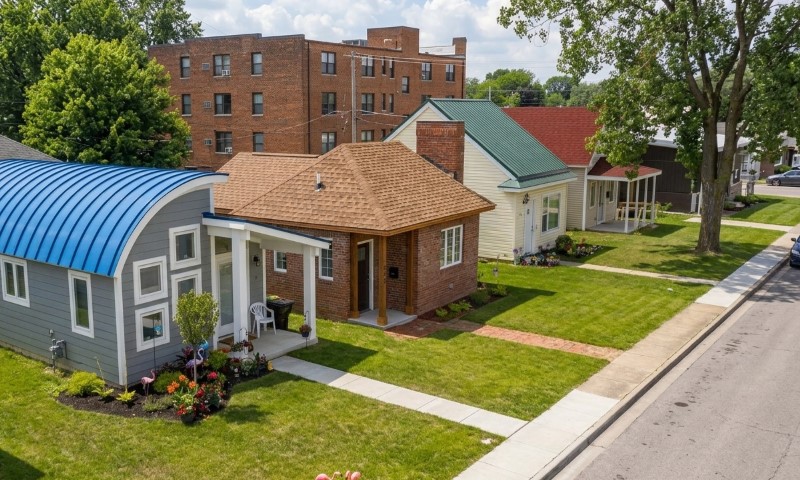
Square footage affects construction expenses, but not every expense changes proportionally with house size.
As builders try to control development costs, reducing the average square footage of a house has become one practical response.
Smaller floor plans can reduce material consumption and labor requirements, although savings depend heavily on the property’s design and location.
Materials, labor, equipment, and finishing work generally increase as homes become larger.
Other expenses are relatively fixed.
Buying a lot, obtaining permits, connecting utilities, and preparing a building site can cost substantial amounts regardless of the proposed house size.
A builder constructing a 1,700-square-foot property still needs many of the same essential systems required for a 2,400-square-foot home.
Design also affects construction costs.
For example, a compact two-story property may require less foundation and roof area than a sprawling single-story house with comparable interior square footage.
Simpler building shapes, standardized dimensions, and fewer complicated roof sections can further control expenses.
However, smaller houses aren’t automatically inexpensive to construct. Premium finishes, difficult building sites, and costly local regulations can quickly erase potential savings.
Removing a few hundred square feet helps with some expenses. It doesn’t persuade the local building department to waive its fees.
Changing Buyer Preferences and More Efficient Layouts
Some Americans genuinely prefer smaller homes.
According to a 2024 National Association of Home Builders study, buyers wanted houses averaging 2,067 square feet, compared with 2,260 square feet in 2003.
That represents a decline of approximately 8.5% in desired home size.
Maintenance expenses, utility costs, and changing household needs all influence those preferences.
Modern floor plans also make it possible to use limited space more effectively.
Open kitchens connected to living areas can replace separate formal dining rooms. Flexible rooms can function as offices, guest bedrooms, or playrooms depending on household needs.
But affordability complicates any conclusion about changing tastes.
A buyer choosing a smaller house might genuinely prefer compact living. Another might simply be purchasing the only property that fits the household budget.
Those are two very different decisions, even if both appear as demand for smaller houses in market reports.
Smaller Homes, Higher Prices – The Reality of Housing Shrinkflation
Recent figures offer a more complicated picture. Average new-home prices actually fell 8.8% between August 2025 and August 2026, although changing home sizes, locations, and builder incentives can influence that figure.
Lower average prices don’t necessarily mean comparable houses have become substantially cheaper.
Between 2014 and 2024, the average square footage of a house in new construction declined by approximately 11.2%. Unfortunately for buyers, the average price per square foot increased by 73.6% during the same period.
Consider the figures:
| Measurement | 2014 | 2024 | Change |
| Average home size | 2,707 sq. ft. | 2,404 sq. ft. | -11.2% |
| Average price per sq. ft. | $97.25 | $168.86 | +73.6% |
Buyers effectively received 303 fewer square feet while the average price per square foot increased by nearly three-quarters.
A smaller floor plan can reduce a home’s overall asking price compared with a larger alternative in the same development. However, it doesn’t necessarily mean buyers are getting better value.
What Does Shrinkflation Look Like in Actual Dollars?
Applying the reported average price per square foot to the reported average house size produces the following illustrative calculations:
- 2014 – 2,707 square feet × $97.25 = approximately $263,256.
- 2024 – 2,404 square feet × $168.86 = approximately $405,939.
Those calculations aren’t official average sale prices because average square footage and average price per square foot don’t necessarily describe an identical mix of properties.
Nevertheless, they show why smaller construction hasn’t automatically translated into lower housing costs.
Regional conditions also matter.
Between 2014 and 2024, average new-home sizes declined approximately 13.2% in the South, 10.4% in the West, and 10% in the Midwest. Meanwhile, the Northeast recorded a modest 2.1% increase.
Land availability, local demand, building regulations, and construction costs can produce very different outcomes across markets.
A compact house in an expensive metropolitan area can easily cost more than a significantly larger property in a smaller city.
Real estate has always been local. National averages are useful, but nobody buys the national median home.
What Does This Mean for Homebuyers?

Smaller houses aren’t necessarily inferior properties. In some circumstances, a well-designed 1,800-square-foot house can accommodate daily life more comfortably than a poorly planned 2,400-square-foot property.
Lower purchase prices, reduced utility consumption, and fewer maintenance responsibilities can make compact homes attractive.
However, limited storage, smaller bedrooms, and fewer dedicated rooms deserve consideration, particularly for growing families.
Practical buyers should examine several factors before deciding how much square footage they actually need.
| Factor | What to consider |
| Floor plan | Usable room dimensions and overall layout |
| Storage | Closets, garage capacity, and utility areas |
| Monthly expenses | Mortgage, taxes, insurance, and utilities |
| Household needs | Bedrooms, working space, and future changes |
| Resale potential | Local demand for smaller properties |
Square footage alone can also be misleading.
A 2,000-square-foot house with awkward hallways, oversized entryways, and poorly positioned rooms may feel less practical than a smaller property with an efficient layout.
Buyers comparing new construction should also examine existing homes in the same market.
An older property might offer more square footage at a similar price, although repairs, energy efficiency, and ongoing maintenance could change the financial comparison.
First-time buyers may benefit particularly from considering smaller new homes and townhouses. Still, a manageable asking price should never replace a careful evaluation of total ownership costs.
Is Smaller the New Normal?
Recent construction trends suggest that the average square footage of a house could continue declining as builders respond to affordability pressures. However, smaller floor plans alone won’t resolve the larger problem of expensive homeownership
Affordability pressures have encouraged builders to reconsider floor plans, while some buyers have become less interested in paying for space they rarely use.
Future changes will depend on mortgage rates, land availability, construction costs, and household finances.
None of those factors guarantees that houses will continue shrinking indefinitely.
Older housing markets offer a useful reminder that square footage has never been the only measure of a good property.
Plenty of modest homes have accommodated generations of families, just as plenty of oversized houses have created unnecessary expenses.
Buying the biggest house a lender will finance might sound satisfying on moving day. Living comfortably with the payments for the next 30 years is considerably more important.

Home Stats Report
Home Stats Report takes a practical, numbers-first look at the American housing market, drawing on decades of real estate experience, historical trends, and the everyday realities of buying and selling homes. Housing has never been as simple as a headline suggests. Home prices rise, mortgage rates change, inventory tightens, and buyers adjust their expectations. Home Stats Report provides market commentary, analysis, and general information for educational purposes only. We do not offer financial, investment, mortgage, or real estate advice.
All reports by Home Stats Report