
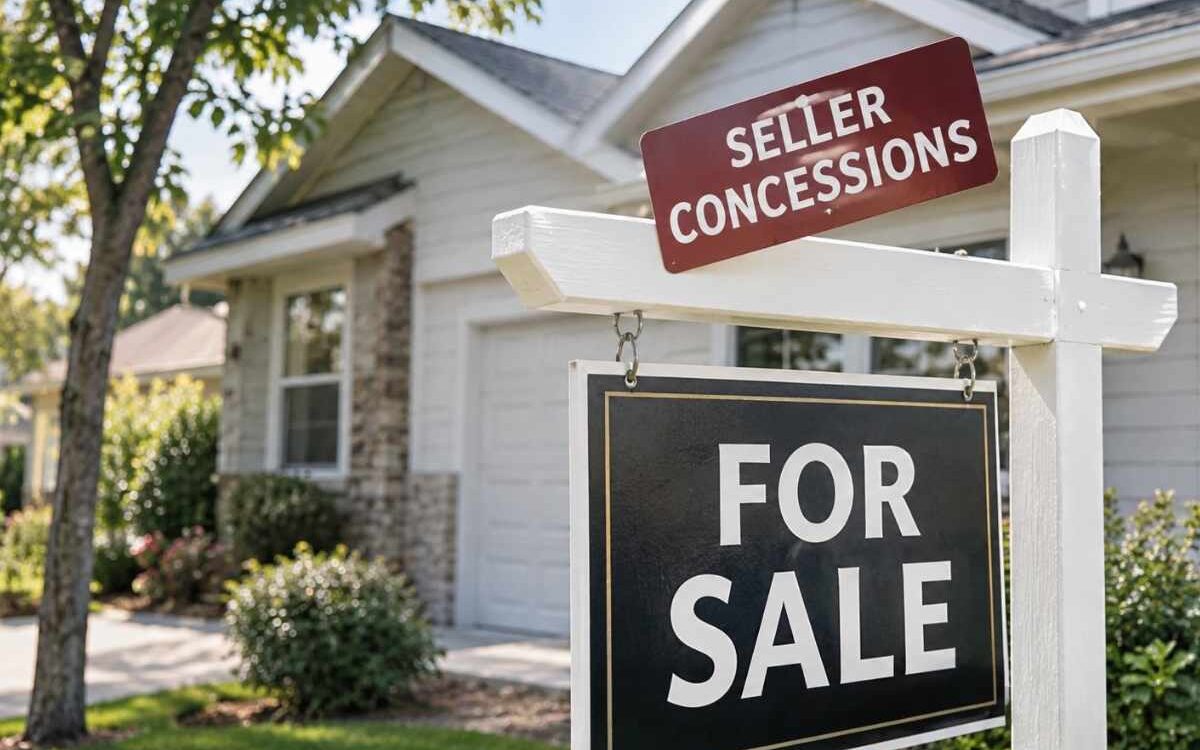
Home sellers are increasingly discovering that finding a buyer sometimes requires offering a little something extra.
During the three months ending August 2026, sellers provided concessions in 44.7% of U.S. home sales, compared with 42.6% a year earlier. That marked the highest August share in records dating back to 2020.
Buyers are negotiating closing-cost assistance, repair credits, and mortgage-rate buydowns, expenses that sellers might have been less willing to cover in a more competitive market.
An increase of 2.1% might not sound particularly dramatic.
But it points to a housing market where sellers can no longer assume that listing a property will produce several eager buyers.
Still, nearly half of sales involving concessions does not mean nearly half of sellers are desperate.
Local housing conditions tell a considerably more complicated story.
Why More Sellers Are Offering Concessions

More homes available for sale, fewer competing buyers, and persistently high ownership costs have changed the negotiating process.
Financing costs are also creating a noticeable divide between buyers. While mortgage-dependent buyers must account for interest rates and monthly payments, cash buyers can avoid those borrowing expenses entirely.
In fact, more than a quarter of homes sold in August were paid for in cash, showing that a substantial share of transactions involved buyers who didn’t need mortgage financing.
According to Redfin’s September 2026 housing market analysis, August was the strongest buyer’s market in its records dating back to 2013.
For sellers, that creates an uncomfortable choice. Lower the asking price, offer financial incentives, or risk watching the listing accumulate days on the market.
Concessions provide a way to make a transaction more attractive without necessarily reducing the agreed sale price.
Consider a seller asking $400,000 for a property. A buyer might agree to that price but request $8,000 toward closing costs.
If accepted, the seller effectively receives $392,000 before commissions and other selling expenses, while the buyer needs $8,000 less cash at closing than without the credit.
A straight $8,000 price reduction would produce the same $392,000 purchase price, but it would not provide the same immediate cash assistance.
Of course, financing rules, appraisal requirements, and available closing costs can limit how much assistance a buyer actually receives.
As the Consumer Financial Protection Bureau explains, seller-paid closing costs are not automatically free savings. Buyers sometimes accept a higher purchase price in exchange for those credits, effectively financing the expense over time.
That distinction matters when evaluating an apparently generous offer.
Where Buyers Have the Most Negotiating Power

National figures become much more interesting when compared with individual housing markets.
Concessions were particularly common across several Sun Belt metropolitan areas during the three months ending August 2026:
Atlanta leads the group, with concessions appearing in nearly three out of every four home sales.
Charlotte and Phoenix follow closely, suggesting that sellers in these markets face substantial pressure to compete for buyers.
Phoenix offers another revealing comparison. Its concession rate increased by 15.3% compared with August 2025, considerably faster than the national increase of 2.1%.
More available housing has given buyers additional alternatives, particularly in markets where construction and listings have increased competition.
For a closer look at why buyers currently have more room to negotiate, watch the video below.
San Jose presents almost the opposite situation. Only 4.2% of sales involved concessions, indicating that sellers generally retained substantially more negotiating power.
New York’s 5.7% figure tells a similar story.
A buyer in Phoenix might have several comparable properties to consider and room to request assistance.
Someone purchasing in San Jose could encounter a market where making additional demands carries a greater risk of losing the property.
Even within one metropolitan area, neighborhood, property condition, and asking price can change the negotiating balance.
Even nationally, buyers have gained some breathing room. September 2026 ended with 1.60 million existing homes available for sale, up 4.6% over the previous year.
That represented 4.8 months of supply at the current sales pace. Buyers have more time to compare properties, although that hardly guarantees every seller will negotiate.
Buyers Are Getting Price Cuts and Extra Incentives

Some buyers are negotiating more than one financial advantage.
During the three months ending August 2026, 15.8% of U.S. home sales involved both a price reduction and seller concessions, slightly above the 15.6% recorded a year earlier.
That was also the highest August share in the available records.
One distinction matters here. A negotiated price reduction and a seller concession are separate arrangements, even when both lower the buyer’s effective purchase expenses.
Common concessions include:
| Concession type | How it benefits buyers |
| Closing-cost assistance | Seller covers eligible closing expenses, reducing upfront costs. |
| Repair credits | Seller provides funds or credits for inspection-related repairs instead of completing them. |
| Mortgage-rate buydowns | Seller helps lower mortgage payments through a temporary or permanent interest-rate reduction. |
For example, consider a hypothetical buyer financing $360,000 with a 30-year fixed-rate mortgage. At 6.5% interest, monthly principal and interest payments would be approximately $2,275. At 6.0%, they would fall to approximately $2,158.
Calculation assumes a permanent rate reduction on a $360,000, 30-year fixed mortgage.
Taxes, insurance, and other ownership expenses are excluded. Actual buydown costs depend on the lender and loan terms.
A permanent reduction could save a buyer thousands over the mortgage term, although the upfront cost of obtaining that rate must be considered.
Buyers considering a temporary buydown should calculate their payments using the full mortgage rate, not just the discounted introductory rate. A smaller payment during the first year means little if the regular payment becomes difficult to manage afterward.
They should also verify seller credits against their Closing Disclosure, as explained in the CFPB’s closing-cost guidance.
One overlooked issue is the difference between receiving cash assistance and purchasing an affordable property.
A seller covering $10,000 in expenses might make closing easier, but the buyer still faces mortgage payments, property taxes, insurance, maintenance, and potentially higher repair costs.
More Negotiating Room Doesn’t Mean Affordable Housing
Rising seller concessions indicate a gradual shift in negotiating power, not a nationwide housing market collapse.
Sellers in slower markets increasingly need to compete for offers. Sellers in more competitive areas can still negotiate with considerably greater confidence.
For buyers, knowing that concessions are common provides a useful starting point, particularly when comparing properties that have spent several weeks on the market.
But financial assistance should never distract attention away from the total cost of ownership.
A seller covering a few thousand dollars in closing costs is certainly welcome. It does not make an expensive house affordable, and buyers still need to run the numbers.

Home Stats Report
Home Stats Report takes a practical, numbers-first look at the American housing market, drawing on decades of real estate experience, historical trends, and the everyday realities of buying and selling homes. Housing has never been as simple as a headline suggests. Home prices rise, mortgage rates change, inventory tightens, and buyers adjust their expectations. Home Stats Report provides market commentary, analysis, and general information for educational purposes only. We do not offer financial, investment, mortgage, or real estate advice.
All reports by Home Stats Report