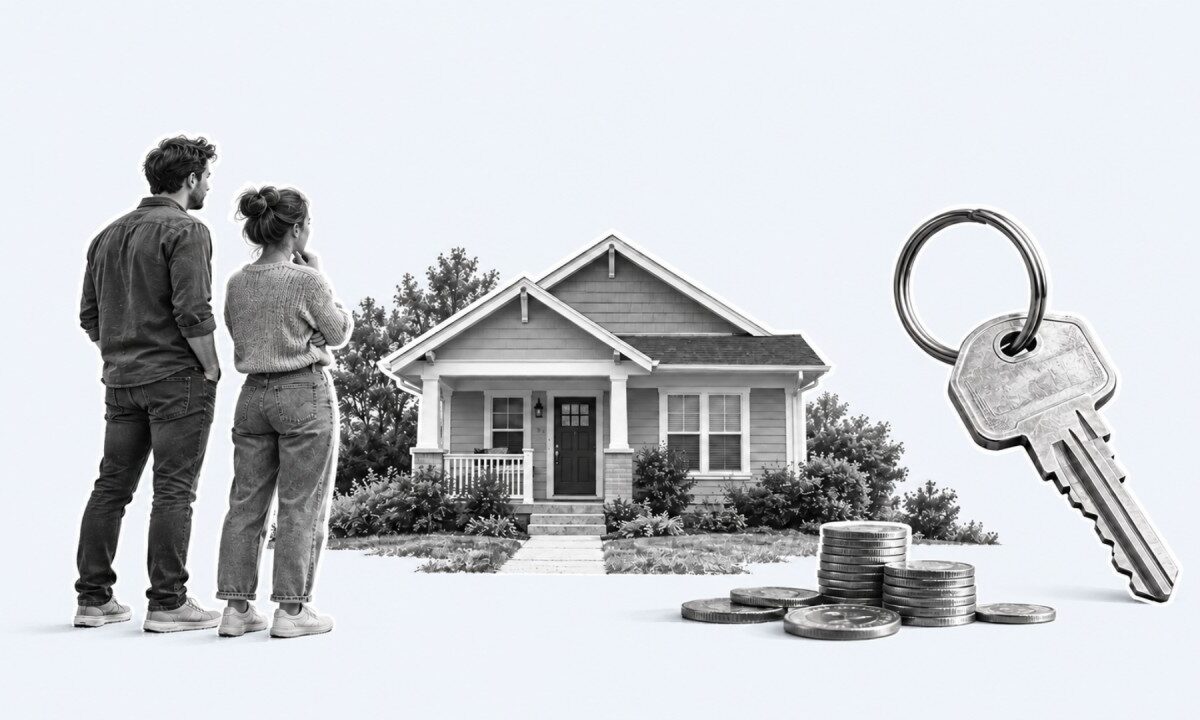
Only 36.8% of U.S. households headed by someone under 35 owned their home in 2026.
At first glance, that number seems to tell a simple story. Young Americans are having a very difficult time buying houses. Affordability certainly supports that conclusion, but one detail deserves attention before we go any further.
Familiar homeownership statistics count households, not individual adults.
A national percentage can tell you something useful about housing. It just helps to know exactly what it counted before deciding what it means.
Recent Census-based data put the conventional homeownership rate for households under 35 at roughly 37%, almost identical to the 2026 figure. Someone looking only at that percentage could reasonably conclude that a little more than one-third of young adults own homes.
Actual individual ownership appears considerably lower.
Individual Homeownership Looks Even Lower
Only 22% of adults under 35 actually own the residence where they live, compared with roughly 37% under the traditional household calculation.
A similar gap appears across the entire adult population. About 53% of individual adults own their residence under the person-level calculation, compared with 65% under the conventional measure.
One reason for that gap is hiding inside millions of perfectly ordinary households.
About 14% of U.S. adults live in an owner-occupied home without personally owning it. Adult children living with their parents create the largest adjustment, reducing the measured ownership rate by 8.6 percentage points when ownership is assigned to individual adults.
Imagine a 30-year-old living in a house his parents own. Household statistics see an owner-occupied home. A person-level calculation sees three adults, perhaps only two of whom actually own it.
Both calculations can be correct. They simply answer different questions.
For anyone trying to judge how many young adults have personally reached homeownership, 22% may be the more revealing number.
So 36.8% is hardly exaggerating the difficulty younger Americans face. Individual-level data actually make their position look weaker.
More Young Adults Are Living With Their Parents

A record 25.2 million Americans ages 25 to 35 lived with their parents in 2025. That works out to roughly one-third of people in that age group.
In 2025, 49% of adults under 30 lived with a parent, up 6% since 2022 and 12 points since 2019. A change that large over six years is difficult to explain as nothing more than young adults suddenly deciding they enjoy their childhood bedrooms.
Calling all of them unemployed adults who cannot get started would miss an important detail. Roughly 70% had jobs.
Employment, in other words, does not guarantee that moving out makes financial sense.
Median asking rents sat 18% above pre-pandemic levels. Median home listing prices were 34% higher.
Those increases matter because young adults usually encounter both markets in sequence. Renting is often supposed to provide the bridge between leaving home and eventually buying. When rent consumes more income, saving a down payment becomes harder. When home prices rise at the same time, that target also moves farther away.
Earlier co-residence patterns show how unusual today’s numbers have become. Had older living patterns simply continued, roughly 4.86 million fewer young adults would now be living with their parents.
Living at home at 29 may be perfectly sensible. Plenty of families prefer it, and saving several years of rent can be financially useful.
When millions more people are doing it than earlier generations did at the same ages, though, it stops being only a family decision and starts becoming a housing story.
Buying Is Harder for More Reasons Than Price
Home prices get most of the attention because they produce the easiest headline.
Mortgage payments, down payments, insurance, property taxes, maintenance, closing costs, and whatever repair the inspector missed all eventually arrive at the same checking account.
First-time buyers made a median 10% down payment in 2025, the highest level recorded for that group since 1989. More than one in five, 22%, used a gift or loan supplied by relatives or friends to help fund the purchase.
Saving for a house has never required perfect arithmetic, but considerably more family money can change who gets to participate.
A $350,000 house can feel affordable or impossible depending on the mortgage rate, taxes, insurance, debt payments, and cash left after closing.
Double-digit mortgage rates were real. Weak local economies were real. Buyers stretched their budgets long before anyone could post the experience online. Cheap houses sometimes needed expensive work, and plenty of closings involved financial gymnastics that would look familiar today.
Current buyers face their own difficult combination.
Starter homes show how much that combination has changed. A typical entry-level home cost about $256,000 in 2019 and $344,000 in 2026.
More importantly, for someone trying to qualify for a mortgage, the estimated household income needed to buy one jumped from about $43,000 to $78,000.
Household incomes increased over that period too, just nowhere near as quickly as the income needed to get through the front door.
A listing price has never been the whole cost of owning a house. Buyers eventually meet the mortgage payment, insurance bill, property taxes, and whatever somebody once described as an “easy weekend repair.”
Young Americans Are Still Buying, Just Later
One popular statistic needs similar caution.
Claims that the typical first-time homebuyer has suddenly become 40 years old attracted plenty of attention. Larger datasets tell a less dramatic story.
Census-based analysis placed the median first-time buyer at age 35 in 2025, after age 36 in 2024.
Other large datasets came in lower. Mortgage and credit research placed the median at 34, while another major mortgage dataset put it at 32.
None of those numbers make affordability look good. All of them suggest that age 40 should not automatically be treated as the normal first-time-buyer age.
Methodology explains much of the disagreement.
One widely cited survey producing the age-40 figure received 6,103 responses after more than 173,000 questionnaires were sent out. That is a response rate of about 3.5%.
Large Census, mortgage, and credit datasets capture much bigger populations and arrive at noticeably younger ages.
Survey data are not useless. Neither are Census records or mortgage files perfect measures of every buyer. Still, when one dramatic number disagrees with several broader datasets, a little skepticism is healthy.
Over time, we learned to become suspicious whenever somebody described the housing market with one adjective. We feel much the same about statistics that turn a complicated generational shift into one spectacular number.
Evidence still says younger Americans face a harder affordability problem. It simply does not clearly say that ordinary first-time ownership has suddenly moved all the way into middle age.
Homeownership Has Not Disappeared, but the Path Has Stretched
Evidence does not show that Americans under 35 have abandoned homeownership.
Millions are still buying houses, and large datasets suggest many first-time buyers continue to reach ownership during their early or middle 30s.
Yet younger adults are clearly reaching that point under more pressure.
Comparing 36.8% with 22% may be the most useful place to end. One figure describes owner-occupied households headed by someone under 35. Another gets closer to answering a more personal question: how many individual adults under 35 actually own their residence?
Millions more young adults are also living with parents, even though most of them have jobs. Rents cost more. Homes cost more. Mortgage financing costs more than it did during the extraordinarily cheap borrowing years early in the decade.
None of that means a starter home has become extinct.
We remember when a $200,000 listing made people stop and look twice. In plenty of markets today, buyers would simply like to know where they can find one.
We would not declare the starter home dead. But considerably more young Americans are standing outside the front door, and the numbers give us a fairly good idea why.

Home Stats Report
Home Stats Report takes a practical, numbers-first look at the American housing market, drawing on decades of real estate experience, historical trends, and the everyday realities of buying and selling homes. Housing has never been as simple as a headline suggests. Home prices rise, mortgage rates change, inventory tightens, and buyers adjust their expectations. Home Stats Report provides market commentary, analysis, and general information for educational purposes only. We do not offer financial, investment, mortgage, or real estate advice.
All reports by Home Stats Report